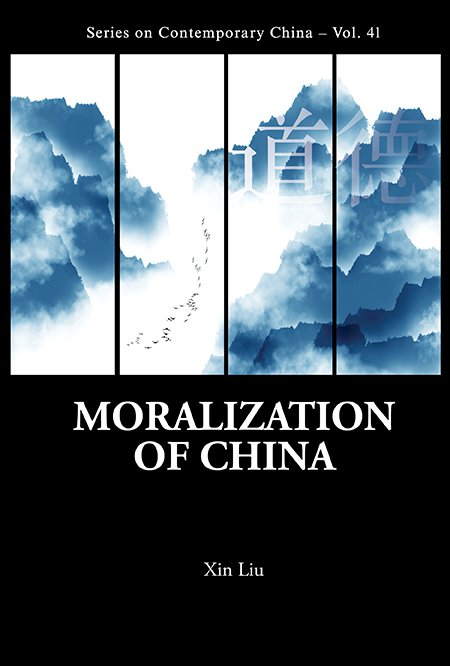
Xin Liu’s `Moralization of China’ (World Scientific, Singapore, 2018: https://www.worldscientific.com/worldscibooks/10.1142/10712) is a provocative book, and written in a provocative way. Readers can’t complain they have not been given a clear warning, when the very first page of the text carries a dedication: `To the Intelligent Few.’ I wondered whether I could dare imagine falling into this cohort, and then started to worry whether it wasn’t a dastardly authorial trap. Being invited to think you are smart, and then being tripped up by an writer exposing one’s hubris and self over-estimation.
I hope it was Xin Liu being playful. But they take no hostages as the book’s argument proceeds. Social media, Maoist China, contemporary Mainland cinema – they all get targeted assessment. However one assesses the drift of the argument (and there are times when it does become a trifle hectoring) the extent of referencing and allusion is impressive. From Canadian philosopher Charles Taylor, to Marx and Foucault, via Weber and a host of other luminaries, the brickbats come thick and fast. I particularly admired the author’s way of continuing the fight not just in the main text but in a series of coruscating footnotes. Great technique. I will definitely try to copy one day.
Round about halfway through the book, on page 78, Liu describes a contemporary Chinese bookshop. This in particular made me lay aside the book and ponder for a while what it is about bookshops in the People’s Republic these days that is so baffling. They are vast places. Chinese people certainly like reading. And going from the number of people in them, they like buying their books in person, not so much online (though I know business there is pretty good). Back in the old days (which for me means the mid 1990s when I was first living in China) there were the cavernous Xinhua bookshops, government run, with vast piles of political tracts, and the usually peaceful acreage devoted to Marxism Leninism and various other ideological matters. On the ground floor though were the more commercially attractive self help and business books. The crowds usually assembled there.
There were smaller bookshops too – and ones that dealt with what passed for second hand books. It was in these, in a place called Book City, that I managed to buy kilos of stencilled and poorly printed leaflets and pamphlets from the Cultural Revolution decade starting in 1966. The Winter day I did that, back in Hohhot in 2000 on a brief visit, meant that finally my doctorate was viable. I had the source material I needed. The shop owner evidently thought Christmas had come early. One other customer jubilantly declared to me while I was leading that the 500 yuan I had spent was a `con’. But in the pavement outside the shop I corrected him. `I know it’s a lot of money’, I said, `but it’s my thesis. I’d have paid ten times this to be honest.’ He looked at me uncomprehendingly, as though I had just achieved the impossible and made my actions seem even dumber.
These days Chinese bookstores are bigger, more commercial and as Xin Liu shows a place where students, migrants, parents, and others can come to while away the time. But they don’t have anything like the aura of the amazing Eslite chain in Hong Kong and Taiwan, whose founder died a couple of years back. These really are places of excitement, full of contesting and contrary ideas in contesting and contrary books by authors from across the world. They have great coffee shops too!
Utopia bookshop near Tsinghua University in Beijing, long since closed down, at least had a certain edginess to it, even if it was busy pushing neo-Maoist and new leftist fare. The `San Lian’ place, linked to the eponymous publisher, issued jewels by writers like the late Yang Jiang (杨绛) and Qian Zhongshu ( 钱锺书). But these days the main offer is either the latest business guru, translations of palatable blockbusters from the West, and then, of course, walls of locally produced political fare.
How you can have such well stocked, popular and, at times, immensely diverse bookshops which at the same time clearly have `edited’ stock – with a lot of material either not available, or available in a form which omits some key issues, is, at every least, symptomatic of the boundaries, visible and invisible, that exist around you in the larger environment of China. Borges could have written something subtle, elegant and revealing about the phenomenon of bookshops in modern China. They are monuments to a certain attitude or disposition, and in a strange way typify the commitment to stability and control which is currently so embedded in the culture. That might be one reason why Xin Liu’s observation is, in my experience, so true: for all the people in Chinese bookshops these days, you sure see a lot of readers who look, for all the world, like they are sleeping. But of course it is very obvious. They are reading through closed eyes.

 Kerry Brown Reviews